Old Dubai in Seven Stops: A Half Day Walking Route for Under AED 20
A walkable Old Dubai route in order: Al Fahidi, the Textile Souk, an AED 1 abra, the Spice and Gold Souks, and Al Seef at sunset. Total cost AED 12.
Most guides to Old Dubai hand you a list and leave you to work out the geography yourself. That is a problem, because the area sits on two sides of a creek, and the difference between a well-sequenced afternoon and a lot of doubling back is significant.
So this is not a list. It is a route, in order, walkable in about four hours, starting from a Metro station and ending at sunset on the water.
The total cost of everything below is AED 12 per person, and that is only because you cross the creek twice. Five of the seven stops are free.
Before You Start
Get there by Metro. Al Fahidi station on the Green Line puts you a short walk from the first stop. Driving into this part of the city is possible but parking is genuinely difficult, and you will end up walking anyway.
Go late afternoon in cooler months, early morning in summer. The route is almost entirely outdoors and mostly unshaded. From roughly October to April, starting around 3 PM lands you at the final stop for sunset. From May to September, start at 7 AM and finish before the heat becomes serious, or split the route across two evenings.
Bring small cash. The abra crossing is cash only, paid directly to the driver after the boat pushes off. Nobody carries change for a hundred dirham note.
One thing to know before you go. Dubai Museum, inside Al Fahidi Fort, has been closed for restoration since 2021 and has no confirmed reopening date. Plenty of guides still list it as an active stop. You can see the fort from outside, and its coral stone walls are worth a look, but you cannot go in. Do not build your afternoon around it.
Stop 1: Al Fahidi Historical Neighbourhood
Free. Open daily, roughly 7 AM to 8 PM.
Start here, because it is the only part of the route that requires you to slow down.
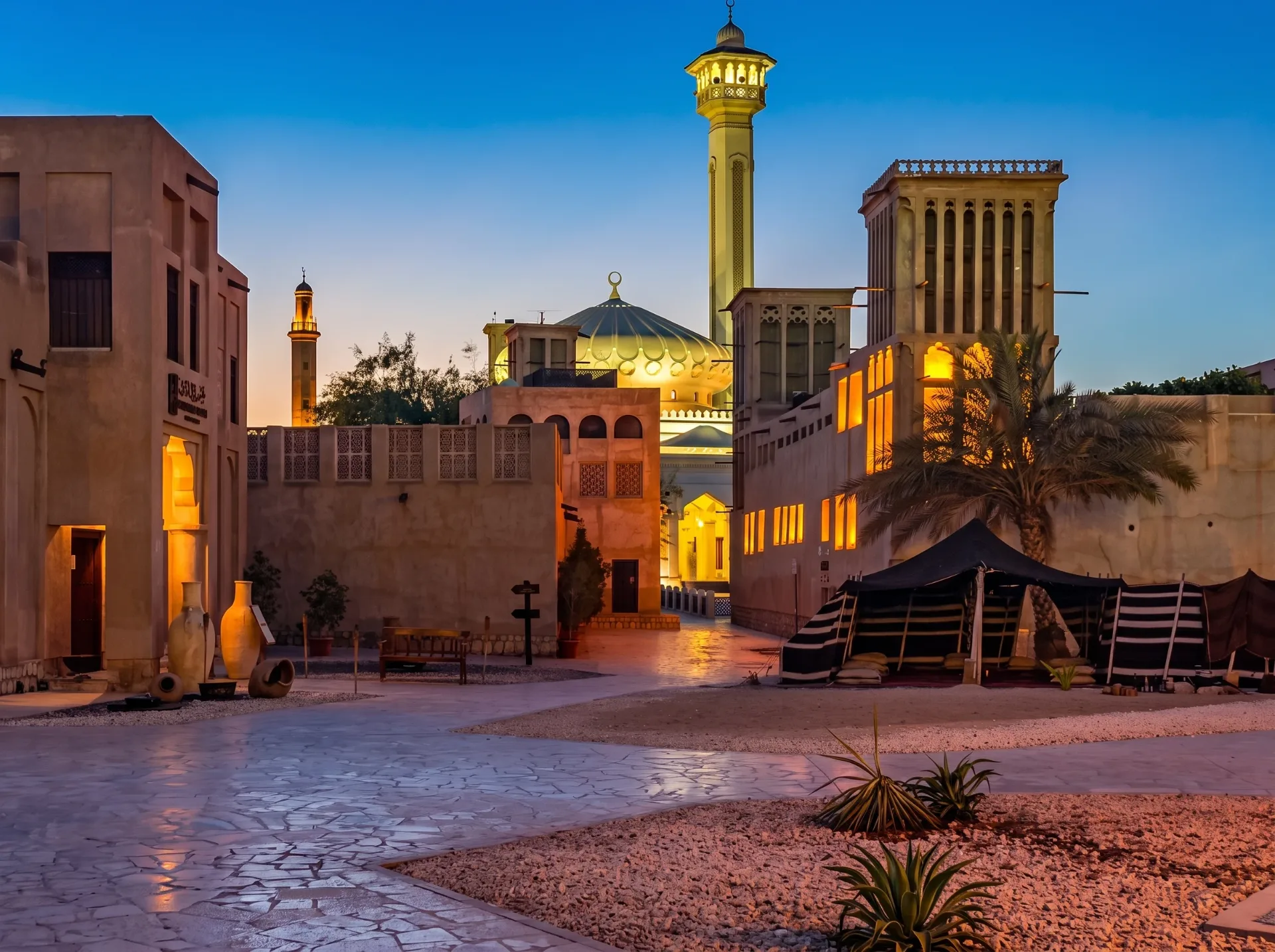
Al Fahidi is a preserved quarter of narrow sand-coloured lanes and wind tower houses, built before oil money reshaped everything a few kilometres inland. The wind towers are the detail worth noticing. They are an early form of passive cooling, catching whatever breeze exists and funnelling it down into the rooms below, and they worked well enough that people lived here comfortably in a climate that now requires constant air conditioning.
Give it forty minutes minimum. The appeal is not any single building, it is the disorientation of standing in narrow shaded lanes and then looking up and seeing towers on the skyline.
Several small galleries operate inside the quarter with free entry, including contemporary art spaces showing work from across the region. Worth ducking into whichever ones are open when you pass.
Stop 2: The Coffee Museum
Around AED 10 to 15. Inside Al Fahidi.
A small museum, but a good one, and the only paid indoor stop on this route.
It covers coffee's route out of Ethiopia and Yemen and into the Gulf, with traditional roasting and brewing equipment and a working area where you can try coffee prepared using older methods. The Arabic coffee tradition here, gahwa served with dates, is not a tourist performance, it is how hospitality actually works in this part of the world.
It also gets you indoors and air conditioned for half an hour, which matters more than it sounds if you are walking this route in warmer months.
Stop 3: The Textile Souk
Free. Bur Dubai, roughly 9 AM to 2 PM and 4 PM to 9 PM, closed Sunday.
A short walk from Al Fahidi toward the water, running under a restored wooden arcade.
This is the calmer of Dubai's souks. Fabric by the metre in every colour, pashminas, scarves, and the usual souvenir overflow. Prices are negotiable and expected to be negotiated, though the pressure here is noticeably lower than across the creek.
The arcade is shaded, which makes this a useful stop between two exposed sections of the route.
Adjoining it is Meena Bazaar, the dense cluster of textile and jewellery shops that forms the heart of Dubai's South Asian commercial district. Even if you buy nothing, walking through it tells you more about who actually built this city than any museum in the emirate.
Stop 4: Cross the Creek by Abra
AED 1. Boats run roughly 6 AM to midnight.
Walk to the abra station at the end of the souk and get on the next boat.
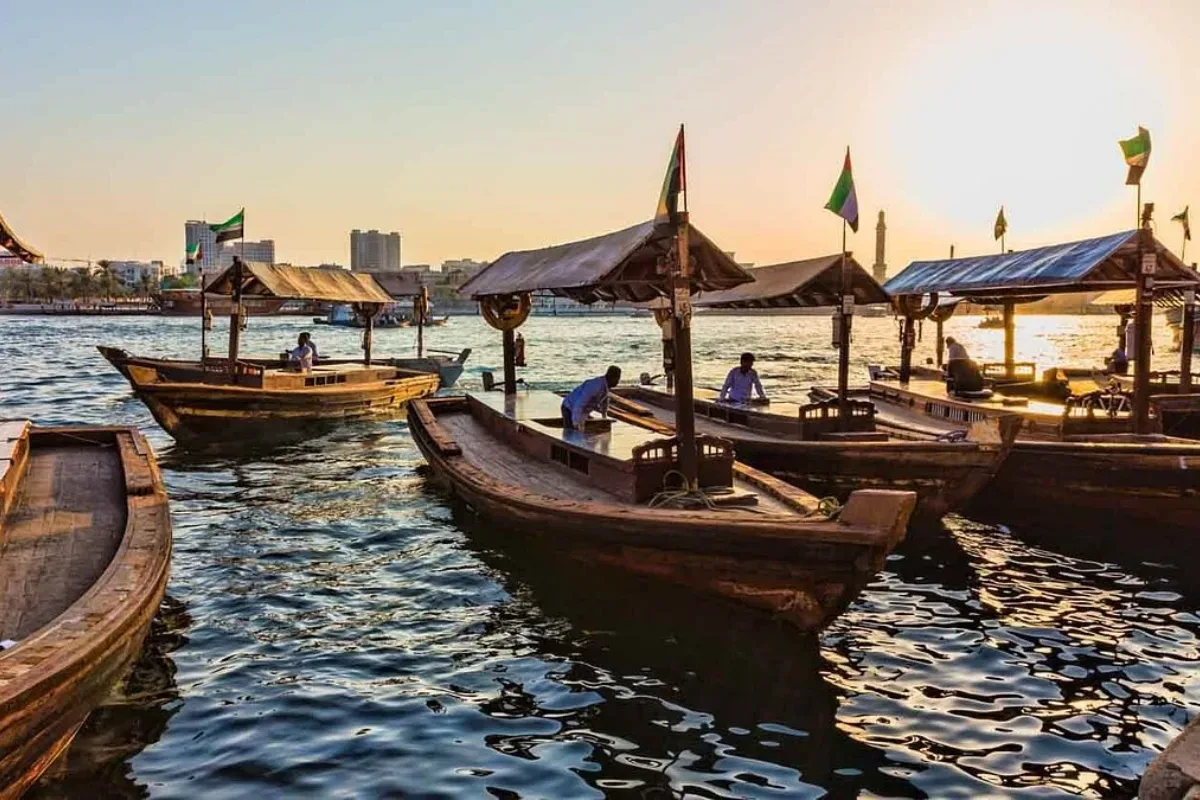
These are small wooden vessels carrying around twenty passengers, and roughly 150 of them work the creek between Bur Dubai and Deira. There is no ticket, no booking, and no schedule. Boats leave when they fill, which is usually within a few minutes. You pay the driver in cash once you are moving.
The crossing takes about five minutes and it is, by a wide margin, the best value experience in Dubai. One dirham for a working boat ride across the water that made this city a trading port, with the skyline visible in the distance behind you.
An air conditioned version runs for AED 2. Take the open one. The point is the open one.
If you want a longer trip rather than a crossing, you can hire an entire abra privately for roughly AED 120 to 150 per hour, which split between a group is still reasonable. But for this route, the one dirham crossing is the correct choice.
Stop 5: The Spice Souk
Free. Al Ras, Deira. Open daily, roughly 10 AM to 10 PM.
You land in Deira a short walk from the Spice Souk, and you will smell it before you reach it.
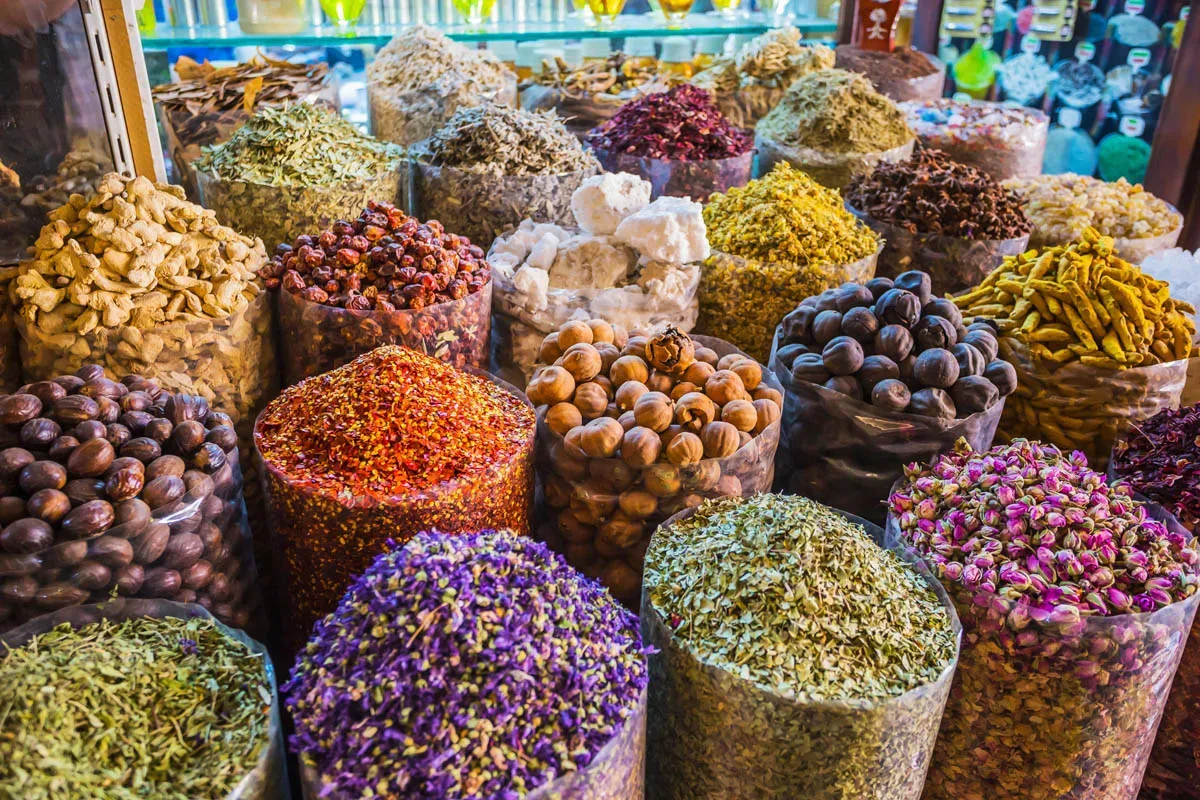
Narrow lanes packed with open sacks of saffron, cardamom, dried lemon, frankincense, chilli, and every shade of amber and red in between. Dried fruit, nuts, oils, and loose tea fill whatever space remains. Traders will call you in, and a certain amount of that is theatre, but the goods are real and the prices are negotiable.
Buy something small if you want, saffron and frankincense travel well, but browsing costs nothing and the sensory experience is the actual attraction. This is the most atmospheric free thing to do in the city.
Stop 6: The Gold Souk
Free. Deira, a short walk from the Spice Souk.
Hundreds of shops in a covered arcade, windows stacked floor to ceiling with gold in quantities that stop making visual sense after the first few storefronts.
The scale is the point. This is one of the largest gold markets in the world, and the volume on display in a single window frequently exceeds what a jewellery shop elsewhere would hold in its entire inventory.
You do not need to buy anything, and most visitors do not. But if you are considering it, gold here is sold by weight at a rate tied to the daily market price, with the negotiation happening over the workmanship charge rather than the gold itself. Knowing that changes how the conversation goes.
Stop 7: Cross Back and Finish at Al Seef
AED 1 for the abra. Al Seef is free, open daily, roughly 10 AM to 10 PM.
Take a second abra back to the Bur Dubai side and walk to Al Seef.
Al Seef is a 1.8 kilometre waterfront stretch built in two distinct halves. One side recreates mid-century Old Dubai in coral stone and narrow lanes. The other is modern, built from contemporary structures along the water. It is a constructed environment rather than a historic one, and it does not pretend otherwise.
What it does exceptionally well is the waterfront itself. Cafes and restaurants line the creek, abras and dhows pass constantly, and the light in the last hour before sunset over the water is the best photography you will get all day.
Sit down, order a karak, and watch the creek work. If you timed the route right, this is where the afternoon ends.
What It Actually Costs
Two abra crossings at AED 1 each, plus roughly AED 10 for the Coffee Museum, comes to AED 12 per person.
Everything else on this route is free. Add food and drink according to appetite, and note that this part of the city is where Dubai's cheapest genuinely good eating happens, so a full meal here need not add much.
Why This Half of the City Matters
Dubai's reputation is built almost entirely on what was constructed after 1990. The towers, the malls, the artificial islands, the record attempts.
Old Dubai is where the city existed before any of that, as a trading port built around a creek, populated by merchants and pearl divers and the communities who arrived by sea from Iran, India, and East Africa and stayed. That history is still legible here in a way it is not anywhere else in the emirate.
You can see all of it in an afternoon, for the price of a coffee. That is a strange and slightly wonderful thing about this city, and it is worth doing before you spend a day at an observation deck.
Find more of the city worth walking, day and night, on Day & Night Dubai.